
BIRDS in BG: Three years of investment in a stronger civil society


When grants and capacity work together
Between 2023 and 2025, Impact Drive Foundation worked side by side with the Bulgarian Fund for Women (project coordinator) and the Bulgarian Center for Not-for-Profit Law (BCNL) on the BIRDS in BG project, a strategic initiative funded under the European Union's "Citizens, Equality, Rights and Values" (CERV) Programme. The project brought together direct funding (grants) with thorough, consistent capacity-building work, so that Bulgarian civil society organizations could not just receive support, but become more sustainable, stronger, and firmly rooted in European values.
Purpose of the project
BIRDS in BG set out to help Bulgarian civil society organizations become more mission-driven, financially independent, and resilient against the pressures of shrinking civic space. The organizational capacity-building component—implemented jointly by Impact Drive and BCNL—was built on four core principles: integrating grants with a structured learning process, focusing on core and strategic support, bringing together the expertise of leading players in Bulgaria's civil sector, and structurally strengthening the sector around fundamental rights, gender equality, and democratic participation.
Impact Drive's portfolio within the project developed along two complementary directions: Impact Hub, a program for organizational sustainability and strategic development; and "Values in Action," building competencies in core European values among practitioners and activists in the civil sector.
Results and activities
Over the course of three years, Impact Drive carried out an intensive program of trainings and meetings:
Impact Hub - a total of 18 training events in three main formats: Design of Social Change, Building Strong Alliances, and Sustainable Organizations (workshops and individual consultations). A total of 264 participants took part, supporting their organizations in strategic planning, partnership building, people management, and developing operational sustainability.
"Values in Action" training – three annual four-day training meetings in Hisarya (2023), Yagoda (2024), and Zhitnitsa (2025), where a total of 58 practitioners worked on the Council of Europe's Framework of Competences for Democratic Culture (CDC), human rights, intersectionality, solidarity, and the RMSOS model for youth participation.
• "Values in Action" networking events – 9 networking meetings on topics such as the rule of law, women's rights, civic participation, diversity, solidarity, and leadership for the public good. A total of 295 participants took part, from the civil sector, public institutions, business, and independent activists and experts.
At the same time, active communication ran in parallel: between 2023 and 2025, Impact Drive published hundreds of original posts, articles, media appearances, and a monthly newsletter, reaching over 70,000 people in Bulgaria.
Impact
The impact of BIRDS in BG goes beyond the numbers. Participants report applying what they learned directly in their work: rethinking theories of change, sharpening their strategies, building alliances, and placing communities back at the center of their work. Follow-up evaluations conducted six months and one year after the trainings confirm that competencies in European values, human rights, and democratic participation are carried back into organizations and, from there, to their beneficiaries and communities.
Particularly telling is the shift seen in the project's third year: organizations are increasingly seeking support not for fundraising tactics, but for leadership, people management, and financial operations. This is a sign of a maturing sector investing in its own backbone. Equally important is Impact Drive's decision to incorporate the Impact Hub series into its permanent training program, so the methodology remains accessible even after the project's end.
BIRDS in BG also demonstrated that when the major organizations in Bulgaria's civil sector join forces, rather than working in parallel, the result is both broader reach and greater depth of impact. The partnerships built during the trainings and networking events continue today, in the form of joint initiatives, shared positions, and mutual support in day-to-day work.
A partnership that endures
For Impact Drive, BIRDS in BG was the longest project we have implemented to date. It showed that when grant funding and capacity building are meaningfully interwoven, lasting change is born. We worked side by side with our partners and with dozens of Bulgarian civil society organizations whose work makes our society more democratic, more just, and more inclusive every day.
The impact of this work doesn't end in the training room. Since 2023, we have been collecting feedback at three points in time: immediately after each training, at the sixth month, and at the twelfth month—a relatively rare practice in the Bulgarian civil sector. The rating immediately after training is, as expected, high: 9.42 out of 10, based on 242 completed questionnaires. More telling is the measurement a year later, when we ask not how the training was rated, but how practically useful it has proven to be. The average rating is 8.57 at the sixth month and 8.62 at the twelfth month. The drop compared to the initial rating is less than one point, and between the sixth and twelfth month the result stabilizes rather than declining.
Even more important than the ratings is the behaviour. 81% of respondents continue to use at least one tool from the trainings, with this share increasing over time - from 75% at the sixth month to 86% at the twelfth. The reason becomes clear in the open-ended responses: the tools are not applied immediately, but when the right moment arrives in the organizational cycle - during the next strategic planning process, the next budget, or the next campaign. The most commonly created document after training is the strategic plan, followed by the communication plan and the annual operating budget; 88% of organizations already have such a plan or are in the process of developing one. As an additional effect, 37% of participants report a new partnership that emerged as a result of the change they undertook.
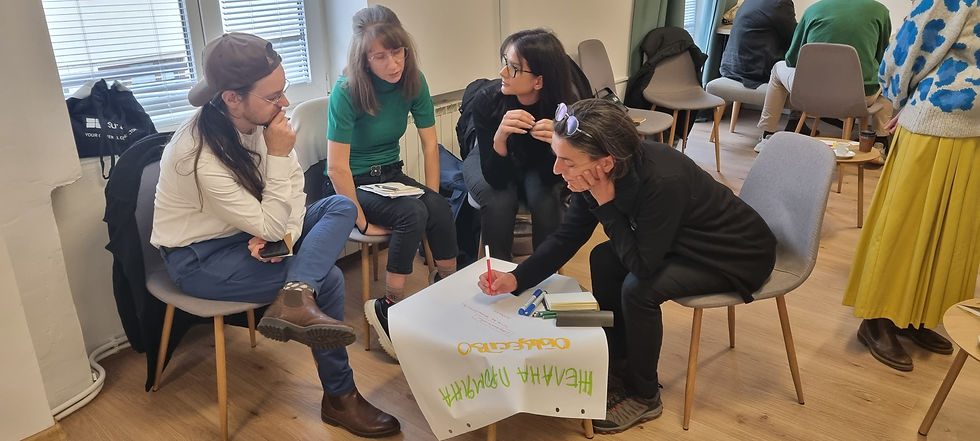
The data also challenges a common assumption: that organizations pursue training because a donor or board requires it. Only 23% cite such an external requirement; the leading motives are the pursuit of effectiveness, growth of activities, and personal interest in learning. This feedback also served as a tool for shaping the programs themselves: after a weaker 2024, we redesigned the "Sustainable Organizations" format, and the ratings rose again by nearly 0.8 points.
The analysis also honestly reveals the limits of this work. The effect is delayed, and standard project indicators, which measure outcomes at the point participants leave the training room, systematically underestimate it. The most common obstacle is not the quality of the training, but the capacity of the organization itself - 56% of participants return alone to a team that was not part of the training. Our conclusion is clear: capacity building does deliver results, but those results emerge later than project funding timelines anticipate. That's why our next step is not more training, but deeper follow-up support for the organizations we work with.


Comments