
Voice and image of civil society organizations

In the flood (deluge) of opinions and information, the greatest challenge is to be heard. We can rise to it with the right support and by joining forces.

On June 8, 2022, the event "Voice and Image of Civil Society Organizations," organized by Impact Drive Foundation, took place at Jamba – Hub of Opportunities.
Communications specialists who have demonstrated their commitment and contribution to the civil sector, along with representatives from various non-governmental organizations, came together in one place. The discussion focused on the most pressing questions around communication from and about civil society organizations, and was moderated across two panels. The event was opened by Teodora Ivanova-Valeva, Executive Director of Impact Drive Foundation, and by Zara Rancheva, representative of the Bulgarian Fund for Women.

The first panel, titled "Communicating Causes Through the Eyes of Experts," set the context for NGO communications in Bulgaria and the trends shaping their development. The panelists were:
Daniel Kiryakov, Communications Manager at the American Chamber of Commerce and co-founder of the Center for Analysis and Crisis Communications (CACC) Deyana Dragoeva, VIA CIVIC Association, lecturer and mentor at DigiComs Anna Kastreva, Tipping Point Strategies, DigiComs mentor
Teodora Ivanova-Valeva moderated the discussion, shaping it into substantial, practical material outlining approaches that open up opportunities for civil society organizations.
The panel highlighted a key feature of communications today: the oversaturation of information and news. This creates a challenge for organizations trying to reach new audiences and have their achievements heard by a society that has grown weary of the constant flow of disparate information.
Daniela Dragoeva noted that organizations truly breaking new ground should take a step back and use metaphors to explain what their work is about, so their causes become easier to understand.
A characteristic still present among some civil society organizations is the lack of a clear image and direction of work, which turns them into an amorphous mass unable to build a specific audience, since they operate across too many areas without achieving depth or expertise.

Daniela Dragoeva emphasized that target groups should awaken their organizations from within, following their own interests, while the role of experts and managers is to empower the people directly affected by a given situation - those who know it best and want to see it change - by helping manage the organization, build community, communicate with them, and guide the process.
Valuable advice and guidance emerged for any organization looking to develop not just its communications, but its work as a whole:
-Clarify or revisit the organization's mission, goals, and activities, and from there, the target groups it addresses
-The language used with each group (direct users of a service or product, donors and sponsors, volunteers, business, politicians, and the broader public) differs and needs to be mastered when shaping communications
-Always keep the goals of the communication in mind, as Deyana Dragoeva emphasized
An important factor in an organization becoming successful and recognizable within society is working deliberately to build its name as a media outlet in its own right, one that educates, informs, and engages. This happens through consistent, sustained, and deliberate work to master communication channels and create suitable content for each of them.
Anna Kastreva and Daniel Kiryakov stressed the need for organizations to join forces as a way to strengthen their reach and capabilities.
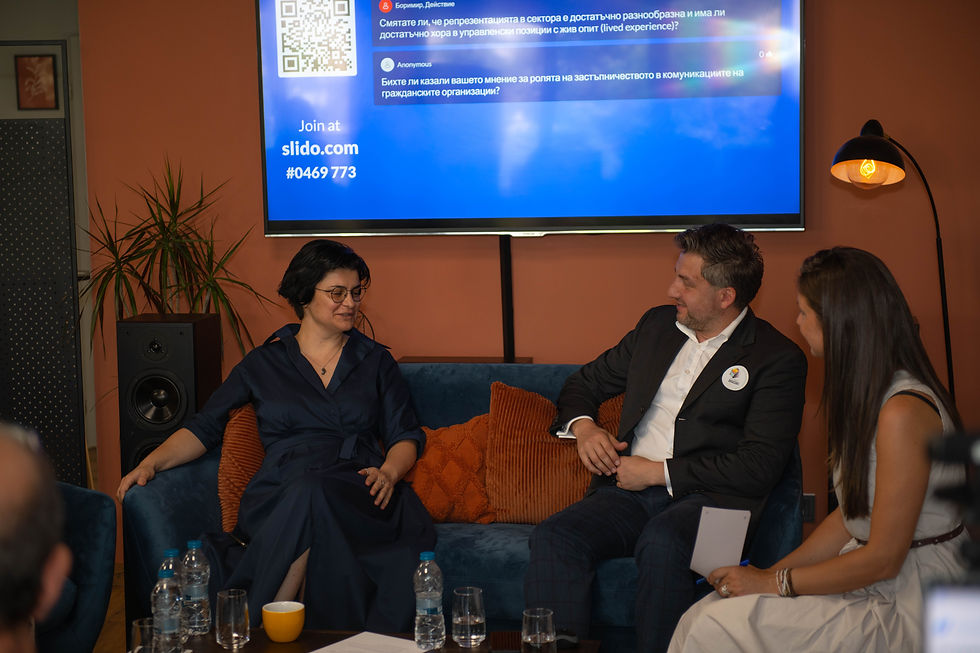
Daniel Kiryakov observed that there is a lack of a sense of community, and that distrust in institutions, the media, and authorities eventually pushes non-governmental organizations into a corner, left on their own if they remain isolated.
Daniel also touched on the importance of educational work within society as essential to organizations' success.
Everyone agreed on the great strength of non-governmental organizations, coming from their direct experience and the vast wealth of stories they hold. It is precisely by sharing these stories that they can illustrate the results of their work, engage and educate, provoke thought, and shape opinions.
Anna Kastreva noted that the fact society has come to recognize the NGO sector as a powerful force in addressing situations like the crisis in Ukraine is a wave worth seizing and building further upon.
At the close of the panel, the call was for organizations to set aside ego and find the courage to ask for help, support, and unity with others, in the name of achieving better results in their work for citizens.
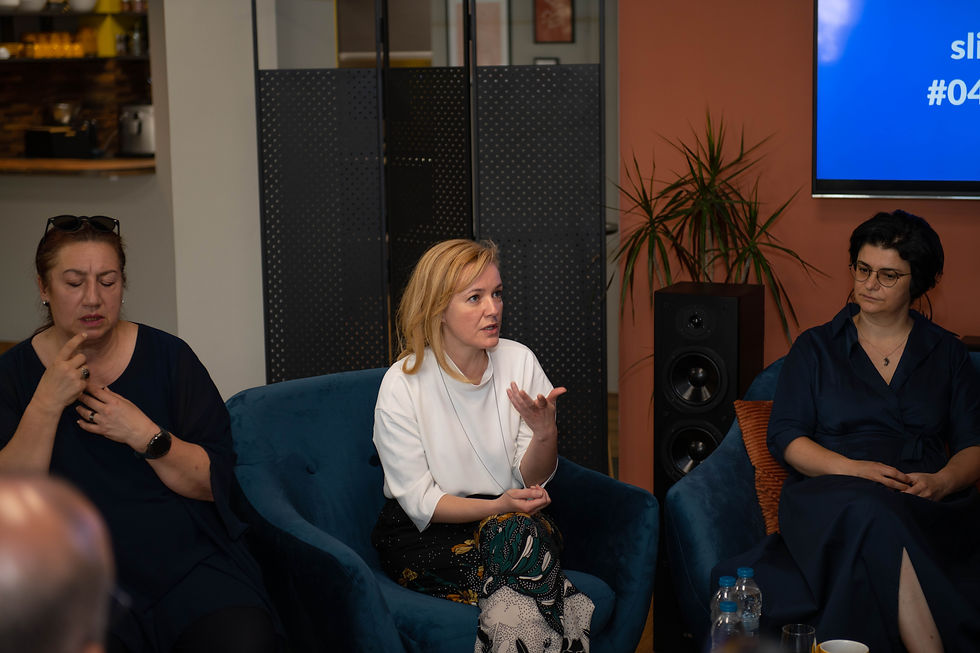
The second panel, titled "Solutions for Managing Communication in the NGO Sector," was moderated by Veselina Panayotova from Impact Drive Foundation. Her fellow speakers were:
Yoana Koleva, co-founder of JAMBA and Managing Chair of Social Future Foundation, and Teodora Ivanova-Valeva, this time in her role as founder of DigiComs.
This panel shared many practical stories from the development of Jamba and the DigiComs model.
Jamba provides opportunities for building capacity, empowerment, and employment engagement for people with disabilities. Over the years, their experience has drawn on a variety of communication methods; for major campaigns, celebrities and advertising agencies have played a key volunteer role in supporting their initiatives.
Yoana Koleva remarked that she believes any advertising agency would take on a cause it believes in, since the benefits of a successful campaign flow both ways, including for the agency itself, and that it's common to see agencies win awards for having created a compelling communication campaign for a non-governmental organization.

Yoana Koleva added that in order to support your core target group, you inevitably need to work with others who can support your activities and efforts, so that the organization's goals can also be achieved.
The idea of building the capacity of people working in the NGO sector, or training new professionals familiar with the nature of the work and the sector's needs for effective, successful communication, gave rise to the project "DigiComs – The Voice of Mission-Driven Organizations." Impact Drive Foundation developed a training method for digital communicators who take on communications for mission-driven organizations, following a specific working method.
The training lays a foundation of basic knowledge about non-governmental organizations and provides knowledge of communications in the digital environment, while also building skills through ongoing practical assignments. Graduates of the course are able to create communication strategies and plans and move on to implementing them, understanding the specifics of different social media platforms and other communication channels, and adapting to their audience and manner of communication.
Teodora Ivanova-Valeva noted that just as there's a fundraising mix, there's also a so-called communication mix, one that brings together messages, tone, and language along with the channels used to reach people, and that it matters not only what language you speak, but also which channel you use and who you're speaking to through it.
The project is aimed at young women from vulnerable groups, and its goal is to help them find flexible work. So far, two cohorts have completed the main course, and the advanced pro-course on communication for fundraising has just wrapped up as well.
As part of the project, a platform has also been developed to connect trained specialists with non-governmental organizations that need communication services. Impact Drive Foundation is ready to respond to inquiries, whether for a communicator or other types of consulting, so that NGOs' work can run more smoothly and at an increasingly larger scale.
The panels closed with a wish for openness, connection, and mutual support among mission-driven organizations. And the conversations between the teams continued well after the event, as they worked to find shared solutions and opportunities for tackling the challenges each organization faces.


Comments